Imperial Cities of Morocco
The Imperial Cities of Morocco are Marrakech, Fes, Meknes, and Rabat. Each city once served as the country’s capital under a different ruling dynasty. Today, all four still hold palaces, mosques, and walled medinas built during their years in power.
If you want a Morocco trip built around history and architecture, these four cities form the natural core of the route. Knowing what makes each one different makes it much easier to plan a trip that fits your time and interests.
This guide covers what imperial city actually means, what to see in each city, how many days to budget, and the best season to go. We’ll also cover how to travel between them, by train or with a private driver.
What Are the Imperial Cities of Morocco?
An imperial city, in the Moroccan context, is a city that served as the capital of the country under one or more ruling dynasties. Morocco monarchy moved its seat of power several times over roughly 1,300 years, and each move left behind a new capital with royal palaces, defensive walls, and religious schools built to match its status. Fes, Marrakech, Meknes, and Rabat each held this role at different points, and Rabat has been the official capital since Morocco’s independence in 1956.
All four cities have historic medinas recognized as UNESCO World Heritage Sites, and each still has a working royal palace used by the monarchy today, even though the king now resides primarily in Rabat. That’s part of why the four cities are so architecturally rich: they weren’t built as museums, they were built to project royal power, and much of that building has survived intact.
- For a deeper look at how these dynasties rose and fell, see our full History of Morocco.
Fes: Morocco Oldest Capital
Fes is the oldest of Morocco imperial cities. It was founded in 789 by Idris I and expanded by his son, Idris II. Fes served as Morocco capital under several dynasties and is still considered the country’s spiritual and intellectual center. It’s home to the University of Al Qarawiyyin, recognized as the oldest continuously operating university in the world.
Plan on at least a full day here, ideally two. Fes El Bali, the old walled medina, is one of the largest car-free urban areas anywhere. Enter through the blue-tiled Bab Boujeloud gate and expect to lose your bearings at least once, most first-time visitors do, which is why a local guide is especially useful here.
Don’t miss the Bou Inania and Al Attarine madrasas, the Nejjarine Museum of Wooden Arts and Crafts, and the Chouara Tannery, where leather has been dyed by hand for centuries. The smell is strong, so most visitors are handed a sprig of mint at the viewing terraces.
- See our tours from Fes if you’re building a trip around this city.
Marrakech: The Red City
Marrakech was founded in 1062 by the Almoravid dynasty and later served as capital under several more. It’s the imperial city most visitors see first, largely because Marrakech Menara Airport has the most international flights of the four. The city sits at the foot of the Atlas Mountains, further south than the other three, and its red sandstone walls give it the nickname the Red City.
Two to three days is enough to see the highlights. Start at Jemaa el-Fnaa Square, busy with food stalls and performers from late afternoon on. The surrounding souks are where most travelers shop, for everything from leather goods to hand-woven rugs. Nearby, the Koutoubia Mosque’s minaret dominates the skyline.
Beyond the medina, the Bahia and El Badi palaces show the scale of 19th-century Moroccan royal architecture, while the Majorelle Garden, once owned by Yves Saint Laurent, and the Menara Gardens offer a slower pace.
- See our tours from Marrakech for itineraries that start or end here.
Meknes: The Quiet Capital
Meknes became Morocco capital in 1673 under Sultan Moulay Ismail, who spent much of his 55-year reign fortifying the city with miles of defensive walls and building palaces, granaries, and stables on a scale meant to rival Versailles. Located about 40 miles from Fes, Meknes sees far fewer visitors than the other three imperial cities, and that’s part of its appeal: prices in the souks are lower, there’s less pressure to haggle, and the pace is noticeably slower.
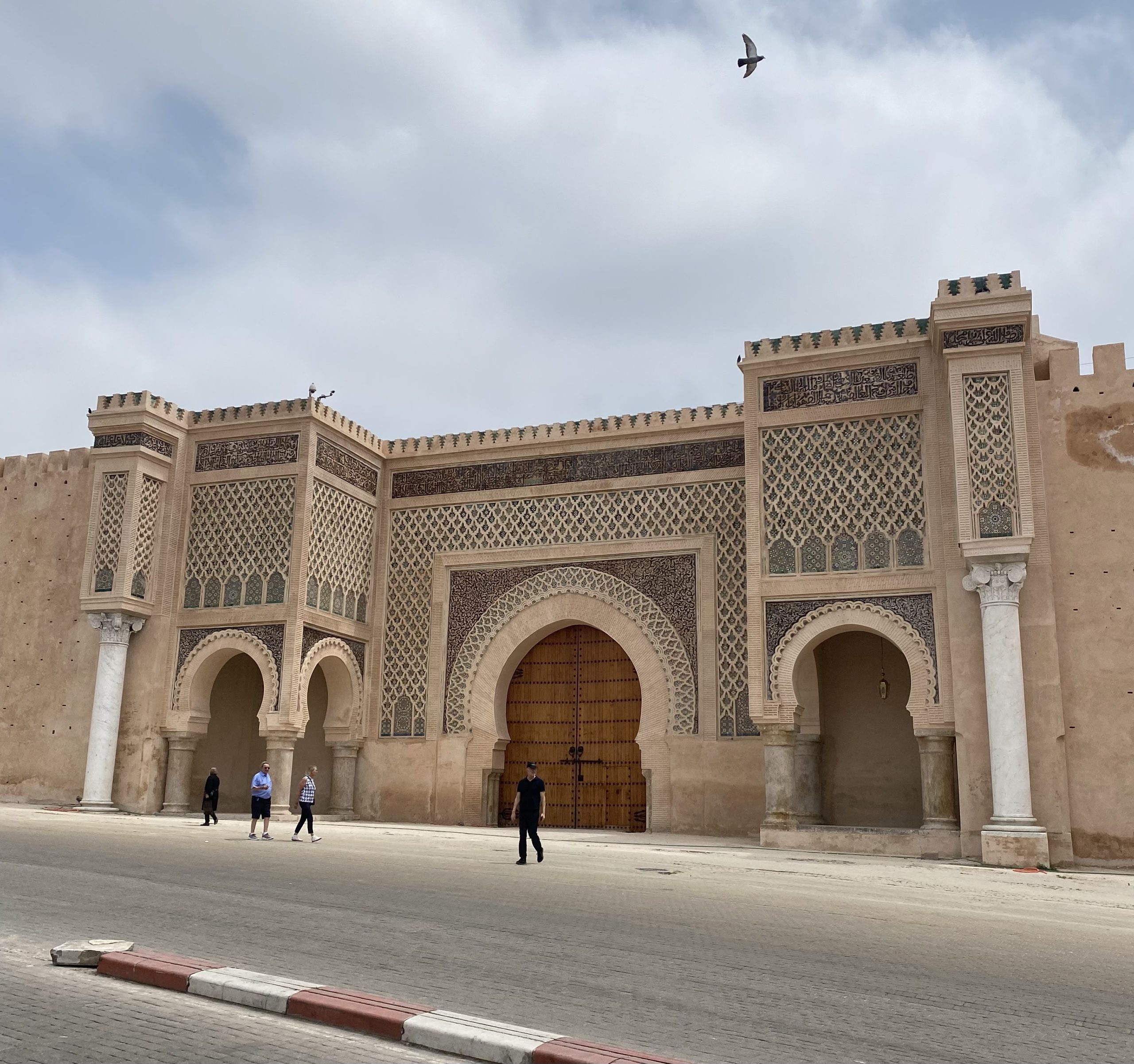
Half a day is usually enough. Start at El Hedim Square, then pass through the Bab Mansour Gate, widely considered Morocco most impressive monumental gate, with its green and white zellige tilework. The Heri es-Souani granaries and the Mausoleum of Moulay Ismail are both a short walk from the square. Most itineraries pair Meknes with a stop at Volubilis, a well-preserved Roman archaeological site about 20 miles north, with mosaics and columns dating back roughly 2,000 years.
Rabat: Morocco Capital Today
Rabat was founded in the 12th century by the Almohad dynasty, but it wasn’t formally Morocco capital until the 20th century, first under the French protectorate in 1912, then permanently at independence in 1956. It’s the imperial city where royal life is most visible today; the king’s official residence sits within the Royal Palace complex.
A day is enough to cover the essentials. The Kasbah of the Udayas, a 12th-century fortress overlooking the Atlantic, is the city’s most photographed spot, with whitewashed and blue-painted lanes and an Andalusian garden. Nearby, the unfinished Hassan Tower stands next to the Mausoleum of Mohammed V.
Compared to Marrakech and Fes, Rabat medina and souks are calmer, and its coastal setting offers a welcome break from the inland heat.
- Read our full guide to Rabat for more detail.
How Many Days for the Imperial Cities?
Most travelers need 7 to 10 days to visit all four imperial cities without rushing, allowing roughly two days each for Fes and Marrakech and a day or less for Meknes and Rabat, plus travel time between cities. A shorter version covering three of the four cities can work in 4 to 5 days if time is limited. Many travelers also extend an imperial cities route with a detour to Chefchaouen, the blue-washed town in the Rif Mountains north of Fes, or combine it with a few days in the Sahara Desert near Merzouga for a longer trip that mixes history with landscape. Our 10 days Morocco tour from Casablanca is built around exactly this combination.
Best Time to Visit the Imperial Cities
Spring (March to May) and fall (September to November) are the best seasons. Daytime temperatures are comfortable for walking the medinas, which have little shade, and evenings are cool enough for a light jacket.
Summer is a different story. Fes, Marrakech, and Meknes regularly climb above 100°F (38°C), and the stone walls of the old medinas hold that heat well into the evening. Rabat, on the coast, stays noticeably cooler.
Winter is mild during the day but can be cold at night, especially in Fes and Meknes, which sit at higher elevation than Marrakech and Rabat.
Getting Between Morocco Imperial Cities
Morocco national rail network, ONCF, connects Casablanca, Rabat, Meknes, Fes, and Marrakech directly. Trains are generally the easiest way to travel between them: comfortable, on schedule, and reasonably priced.
A few reference points: Meknes to Fes takes under an hour. Rabat to Casablanca is about an hour. Casablanca to Marrakech runs roughly three hours on the high-speed line.
Tangier isn’t one of the four imperial cities, but it connects to the same rail network. That’s why many travelers pair a Tangier arrival with a route heading south; see our tours from Tangier for options.
Buses, run mainly by CTM and Supratours, cover routes the trains don’t. Grand taxis (shared cars on fixed routes) are common for shorter distances. Inside each medina, cars can’t enter at all, so pack comfortable, closed-toe shoes; you’ll be walking more than you expect.
Private Tour or Independent Travel?
Both are possible, but a private, driver-led tour solves the two biggest headaches of an independent imperial cities trip, navigating unmarked medina streets and coordinating train or bus schedules between four cities. At Best Morocco Travel, we’ve been running private, customized tours out of Marrakech, Casablanca, Fes, and Tangier for 25 years, and an imperial cities itinerary is one of the routes we build most often for first-time visitors to Morocco. A private driver handles the road time between cities, a local guide meets you in each medina to explain what you’re looking at, and the pace is set by you, not a group schedule. See our Morocco tour packages to see how an imperial cities route can be built around your dates.
FAQ’s About the Imperial Cities of Morocco
What are Morocco imperial cities?
Morocco four imperial cities are Marrakech, Fes, Meknes, and Rabat. Each one served as the country’s capital under at least one ruling dynasty. Rabat has held that role since 1912.
What does royal cities mean?
It’s another name for the same four cities: Marrakech, Fes, Meknes, and Rabat. All four still have active royal palaces, and the two terms are used interchangeably in Morocco travel content.
Which city should I visit first?
Most routes start in Marrakech or Casablanca, since both have the most international flight options, then move north toward Rabat and Fes. There’s no wrong order, it usually comes down to your flight.
Can I visit all four cities in one trip?
Yes. A full route typically takes 7 to 10 days. The cities are close enough together, connected by rail and road, that most travelers combine them into a single loop.
Do I need a guide in the medinas? It’s not required, but it’s worth it in Fes and Marrakech, where the medinas are large and easy to get lost in. A guide can also get you into sites you wouldn’t find on your own.