The Royal Family of Morocco
The Royal Family of Morocco is one of the oldest continuously reigning royal houses in the world. Its line of succession stretches back more than three centuries. Today, the family is led by King Mohammed VI and his son, Crown Prince Moulay Hassan. Together, they sit at the center of Morocco political system, religious authority, and national identity.
For anyone planning a trip through Morocco imperial cities, understanding the Royal Family of Morocco adds real depth to the journey. Royal history is woven into the palaces, monuments, and traditions travelers see along the way.
The Alaouite Dynasty: Morocco Royal History
The Moroccan monarchy is ruled by the Alaouite dynasty. This royal family traces its authority back to the 17th century, and through the Sharifian bloodline, to the Prophet Muhammad. The dynasty’s founder, Moulay Ali Sharif, came from Rissani, an oasis town in the Tafilalt region of southern Morocco.
His mausoleum still draws history enthusiasts and travelers curious about the origins of the Royal Family of Morocco. More than 300 years later, the Alaouite line remains in power. That makes it one of only a handful of ruling families anywhere in the world with such an unbroken reign.
Several Alaouite sultans and kings left a lasting mark on the country. Sultan Moulay Ismail ruled in the late 17th and early 18th centuries. He built Meknes into an imperial capital and is remembered for his ambitious construction projects and centralized rule.
In the 19th century, Sultan Mohammed IV opened new diplomatic and trade relationships with European powers. Then, in the 20th century, King Mohammed V led Morocco to independence from French and Spanish colonial rule in 1956. His son, King Hassan II, spent nearly four decades shaping the country’s modern political institutions before his death in 1999.
King Mohammed VI: The Current Moroccan King
Since July 1999, the Royal Family of Morocco has been led by King Mohammed VI. He ascended the throne following the death of his father, King Hassan II. Before becoming king, he studied law, economics, and social sciences at Mohammed V University in Rabat.
He later completed a doctorate in law at the University of Nice in France in 1993. His thesis examined relations between the Arab Maghreb Union and the European Economic Community. That academic background, combined with years of religious and ceremonial training alongside his father, prepared him for his dual role as political head of state and religious leader.
Under King Mohammed VI, Morocco has carried out significant reforms. These include changes to the family code that expanded legal rights for women, plus a new constitution adopted by referendum in 2011. The country has also seen steady investment in infrastructure, renewable energy, and international trade.
In recent years, the king’s public appearances have become less frequent due to health considerations. Even so, he remains one of the most influential and closely watched monarchs in the Arab world.
Roles and Responsibilities of the King
The King of Morocco holds powers that combine political, military, and religious authority in a single office. As Head of State, he represents national unity and directs Morocco foreign relations. As Amir al-Muminin, or Commander of the Faithful, he also oversees religious affairs across the kingdom.
In addition, he serves as Supreme Commander of the Armed Forces, giving him ultimate authority over national defense. He presides over the Council of Ministers as well, which gives him direct influence over the country’s political direction. Together, these responsibilities explain why the Moroccan monarchy carries so much weight in daily national life, far beyond ceremonial duties.
Crown Prince Moulay Hassan: Future of the Monarchy
Crown Prince Moulay Hassan was born on May 8, 2003, at the Royal Palace in Rabat. He is the heir apparent to the Moroccan throne and the eldest child of King Mohammed VI. He was named in honor of his grandfather, King Hassan II, and is expected to reign one day as King Hassan III.
He completed his secondary education at Lycée Dar es Salaam, a public school in Rabat, graduating with honors in 2020. Since then, he has represented his father at official ceremonies both in Morocco and abroad, including international diplomatic events.
In 2026, King Mohammed VI appointed the Crown Prince as coordinator of the offices and services of the general staff of the Royal Armed Forces. This gave him his first substantive military role, and it mirrors the path the king himself followed as crown prince in the 1980s. Combined with his known interest in aviation, the appointment is widely read as a deliberate step toward eventual succession.
It is also one of the clearest recent signals of how the Royal Family of Morocco manages the transition of power between generations.
Princess Lalla Khadija and the Royal Children
Princess Lalla Khadija was born on February 28, 2007, at the Royal Palace in Rabat. She is the youngest child of King Mohammed VI and the younger sister of Crown Prince Moulay Hassan. She has been educated at the Royal College in Rabat.
Like her brother, she has largely been raised out of the international spotlight while she completes her studies. As she gets older, her public role is expected to grow. This follows a pattern set by earlier generations of Moroccan princesses, who took on cultural and humanitarian responsibilities once their formal education was complete.
The King’s Sisters and Their Public Roles
Beyond the king and his children, the Royal Family of Morocco includes King Mohammed VI’s three sisters. Each holds a distinct public role. Princess Lalla Meryem, the eldest, frequently represents the royal family at international ceremonies and diplomatic functions, acting as one of the monarchy’s most visible ambassadors abroad.
Princess Lalla Hasna has built a long record of work in environmental protection and sustainable development. Princess Lalla Asma, meanwhile, is closely associated with cultural preservation and humanitarian projects across the kingdom.
Their public work reflects a broader set of reforms that have expanded the visibility and influence of women within Morocco royal institution and society at large. Rather than purely ceremonial figures, the king’s sisters run active foundations and initiatives. Their presence at events tied to the arts, the environment, and social welfare has become a familiar part of Moroccan public life.
Royal Family Life: Marriage and Privacy
Like many modern monarchies, the Royal Family of Morocco has faced questions about balancing tradition with a more open public image. King Mohammed VI married Salma Bennani in 2002. The couple was widely seen as a modern, popular pairing that reflected a shift toward openness compared with earlier generations of the monarchy. Their marriage produced two children, Crown Prince Moulay Hassan and Princess Lalla Khadija.
Following their divorce in 2018, Lalla Salma stepped back from public royal duties to focus on raising her children. She is rarely seen at official events today. Still, she is widely regarded in Morocco as an important figure who helped modernize the image of the royal family during her years as princess consort.
The palace has generally handled matters of family privacy with discretion. This reflects the broader Moroccan approach of separating the monarchy’s public duties from its private life.
Royal Palaces of Morocco: Where the Family Lives
The main official residence of the Royal Family of Morocco is Dar al-Makhzen in Rabat. This working palace complex sits near the Kasbah of the Udayas and the Hassan Tower. Visitors cannot enter the palace itself, but many guided city tours stop nearby to view the exterior gates and grounds.
Travelers exploring Morocco four historic imperial cities will notice a pattern. Rabat, Fes, Meknes, and Marrakech each have their own royal palace or gate connected to the monarchy’s long presence there.
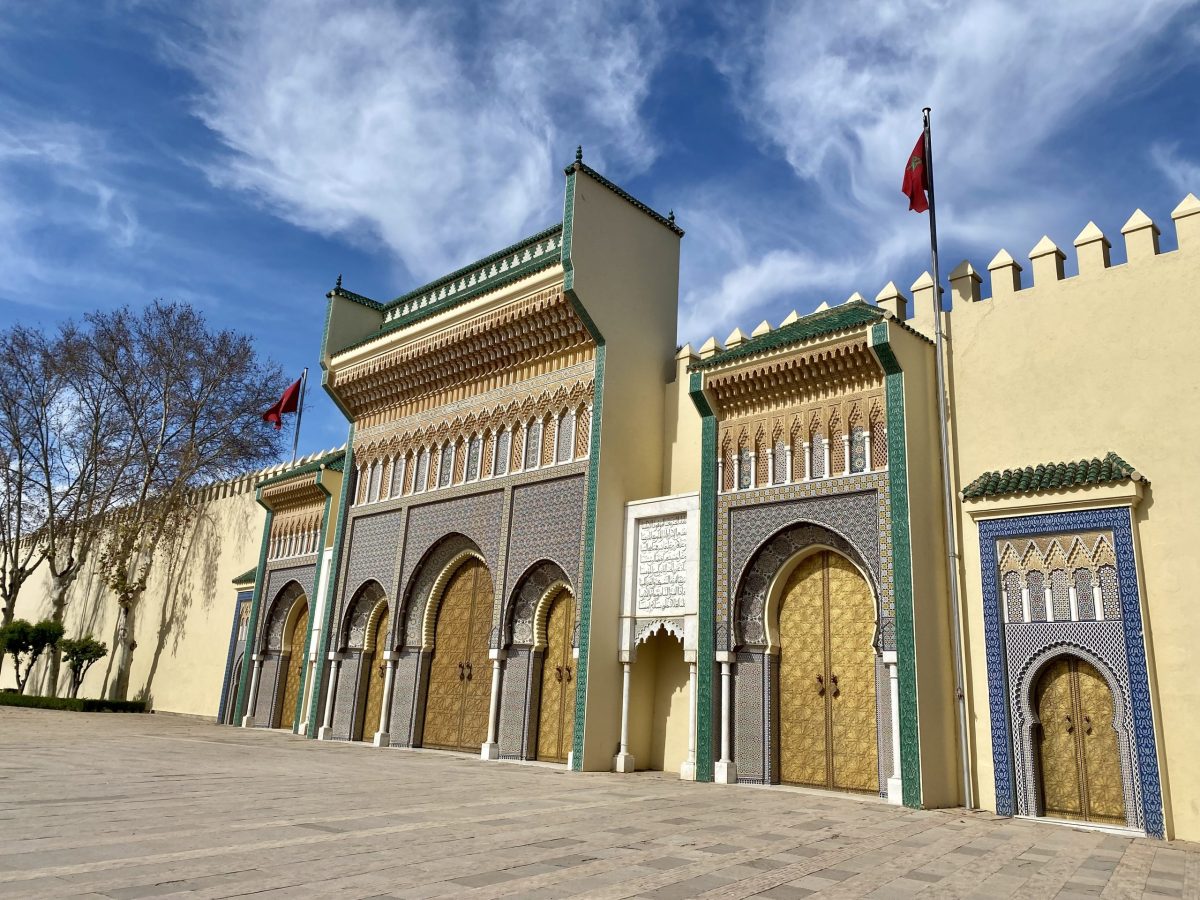
In Fes, tours typically pass the Royal Palace Gate, known locally for its elaborate brass doors, before continuing into the UNESCO-listed medina. Meknes still preserves the royal stables and mausoleum built under Sultan Moulay Ismail. Marrakech has its own royal palace grounds too, alongside the Badi and Bahia Palaces that once housed earlier sultans and their courts.
Seeing these sites in person adds context that most first-time visitors do not get from reading about the royal family alone. An Imperial Cities of Morocco itinerary, or a broader trip that includes tours from Fes or tours from Casablanca, is one of the best ways to experience this history firsthand.
The Royal Family’s Role in Moroccan Culture
The Royal Family of Morocco is more than a political institution. It is a central part of national identity and everyday cultural life. Throne Day, celebrated every July 30 to mark the king’s accession, is one of the country’s most important public holidays. Portraits of the king are displayed in homes, shops, and public buildings throughout Morocco.
National celebrations, religious observances, and even local festivals often reference the monarchy’s role as a unifying force. This matters especially in a country as regionally and culturally diverse as Morocco.
For travelers interested in Moroccan culture, learning about the royal family offers a useful lens. It helps explain everything from local etiquette to the symbolism found in historic architecture. The monarchy’s blend of religious authority, political leadership, and cultural patronage is a big part of why Moroccan traditions feel both distinct and remarkably consistent across regions.
FAQ’s About the Royal Family of Morocco
Who is the current king of Morocco?
King Mohammed VI has led the Royal Family of Morocco since July 1999, when he succeeded his father, King Hassan II.
Who is next in line to the Moroccan throne?
Crown Prince Moulay Hassan, born in 2003, is the heir apparent. He is expected to become the next King of Morocco.
What dynasty rules Morocco?
The Alaouite dynasty has ruled Morocco since the 17th century. It is one of the longest-reigning royal families in the world.
Can tourists visit the royal palaces in Morocco?
Yes, but only from the outside. Tourists can view the exteriors and grounds of royal palaces in cities such as Rabat, Fes, and Marrakech, since the palaces remain active royal residences.
Where does the Moroccan royal family officially reside?
The primary official residence is Dar al-Makhzen in Rabat. The family also has residences in other imperial cities, including Fes and Marrakech.
Explore Morocco Royal Heritage With Us
Learning about the Royal Family of Morocco is one thing. Seeing the palaces, cities, and monuments connected to its history is another. Our team at Best Morocco Travel has spent years guiding travelers through the country’s imperial cities. We build every itinerary around the same local knowledge and attention to detail that shapes our private tours.
Whether you are drawn to Morocco royal history, its architecture, or its living traditions, we design each trip around what genuinely interests you, not a fixed template. To learn more about how we work, visit our About Us page, or get in touch with our team to start planning a private tour that brings this royal history to life.