Flag of Morocco
The Flag of Morocco is one of the country’s most recognizable national symbols. It has a red background with a green five-pointed star in the center, a design that reflects several important periods of Moroccan history. The flag is connected to Morocco monarchy, religious traditions, national identity, and the country’s modern history.
For travelers, learning about the Flag of Morocco is a simple way to understand more about the country before visiting. The red and green flag appears throughout Morocco, from government buildings and public spaces to national celebrations, sporting events, historic sites, and cultural occasions.
What Does the Flag of Morocco Look Like?
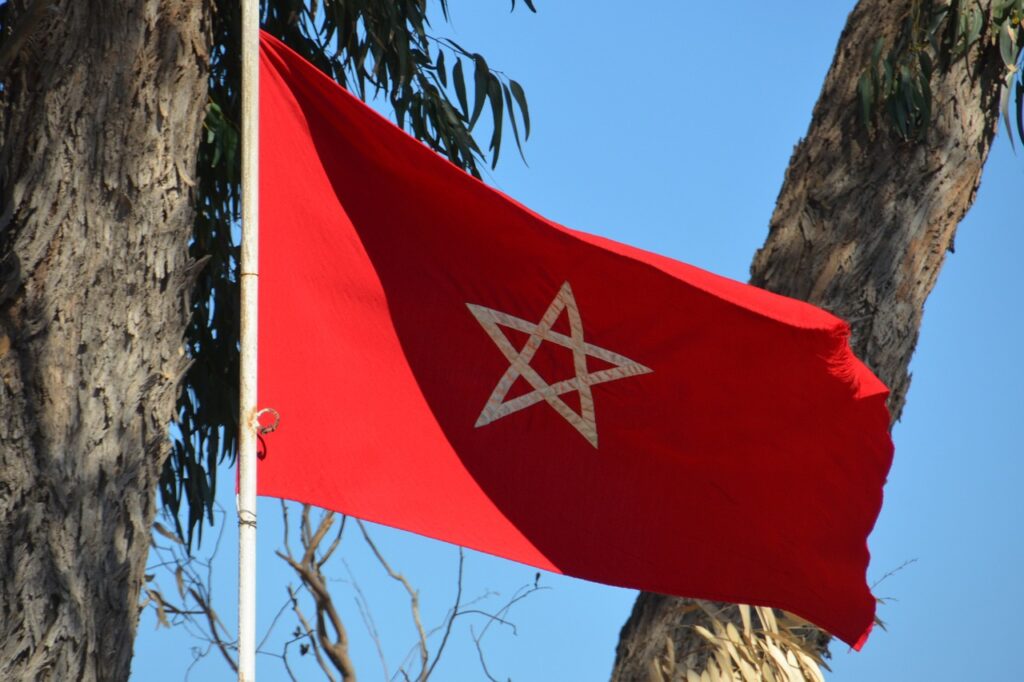
The Flag of Morocco has a plain red field with a green five-pointed star in the center. The star is an interlaced pentagram made from a continuous geometric line. The flag has no writing, stripes, or coat of arms. The red background has older roots in Moroccan history. The green star was added much later, in 1915. This gives the national flag its simple red-and-green design. The Moroccan flag has a rectangular 2:3 proportion. The green star sits in the middle of the red field, making the design easy to recognize.
What Does the Flag of Morocco Mean?
The Morocco flag meaning comes from several periods of the country’s history. Red became closely associated with the Alaouite dynasty and political authority. Green also had long-standing religious and cultural associations in Morocco.
The green pentagram was added to the red flag in 1915. Over time, the symbol gained a stronger connection with Moroccan national identity. During the independence movement, the flag also became associated with national unity and the country’s struggle for independence. Today, the Moroccan flag represents Morocco as a sovereign nation. It also reflects parts of the country’s royal history, religious heritage, and national identity.
Why Is the Morocco Flag Red?
One of the most common questions about the Flag of Morocco is why its background is red. The answer goes back to the history of the Alaouite dynasty. According to Morocco official historical account, red became a symbol of political power with the rise of the Alaouite dynasty in the 17th century.
This is an important part of the flag’s history because the red background existed before the green star was added. Morocco therefore did not create the current flag by simply choosing two colors at the same time. The red field represents an older tradition, while the green star was introduced much later.
Some popular explanations say that red represents courage, strength, bravery, or sacrifice. These descriptions are often repeated when explaining the Morocco flag colors, but the historical connection between red and the Alaouite dynasty provides a stronger explanation for why red became central to the national flag.
What Does the Green Star on the Moroccan Flag Mean?
The green star is the most distinctive feature of the Flag of Morocco. It is a five-pointed interlaced pentagram, commonly known as the Seal of Solomon or Khatam Sulayman. Green has a long religious and cultural history in Morocco. It became associated with religious settings and traditions before it was incorporated into the national flag.
The five points of the star are commonly connected with the Five Pillars of Islam. This is a widely used interpretation of the symbol, although the historical development of the Moroccan flag is more complex than one fixed definition.
The star also developed an important national meaning. During the growth of Morocco independence movement, the green pentagram became associated with national unity and the country’s struggle for independence.
When Was the Flag of Morocco Adopted?
The current Flag of Morocco dates from 1915, when Sultan Moulay Youssef introduced the green five-pointed pentagram on the traditional red flag. The change took place during the period of the French and Spanish protectorates. Adding the green star created a more distinctive national design while preserving the historic red background.
The flag’s importance continued to grow during the Moroccan national movement. The red field and green star became closely associated with Moroccan national identity and the country’s desire for independence. After Morocco regained independence, the same basic red-and-green design remained the national flag.
History of the Flag of Morocco
The history of the Flag of Morocco reaches much further back than the modern design. Morocco has been ruled by several dynasties, and different banners were used during different periods. Earlier Moroccan flags included black and white designs, while green became increasingly associated with religious settings. Later, under the Alaouite dynasty, red became strongly connected with political power.
The development of the national flag can be understood through several stages:
- Earlier dynasties: Moroccan rulers used different colors and banners to represent political authority.
- Alaouite period: Red became strongly associated with the ruling dynasty and state power.
- 1915: A green five-pointed pentagram was added to the red flag.
- Independence period: The flag became an important symbol of Moroccan national unity and independence.
- Modern Morocco: The red field with the green star remains the country’s national flag.
This history shows why the Moroccan flag should not be viewed as a symbol created at one particular moment. Its design developed through political, religious, and cultural changes over many centuries.
What Do the Moroccan Flag Colors Represent?
The Moroccan flag colors are red and green, and each has a different historical background.
Red has a strong connection with the Alaouite dynasty and political authority. It was already used as the main field of the flag before the green star appeared.
Green has longstanding religious and cultural associations in Morocco. It became part of the national flag through the five-pointed star added in 1915.
Together, the red background and green star form one of the most recognizable national symbols in North Africa.
So, if you are asking what does the Moroccan flag represent, the simplest answer is that it reflects Morocco history, sovereignty, religious heritage, national unity, and identity.
Why Does Morocco Have a Five-Pointed Star?
The five-pointed star gives the Flag of Morocco its distinctive appearance. The symbol is an interlaced pentagram with roots in Moroccan and Islamic decorative traditions. Its five points are commonly associated with the Five Pillars of Islam, although this interpretation should be understood as a traditional explanation rather than the only historical meaning of the design.
The star also took on a strong national role during the 20th century. As Morocco independence movement developed, the symbol became associated with unity and the country’s demand for independence. This combination of religious tradition and national symbolism helps explain why the green star remains such an important part of the Moroccan flag today.
Was the Moroccan Flag Always Red and Green?
No. The Flag of Morocco has not always had its present-day appearance. Different Moroccan dynasties used different banners throughout history. Earlier flags could be black or white, while green and red developed different associations over time.
The red field became particularly important under the Alaouite dynasty. The green pentagram was added much later, in 1915. This distinction is useful when looking at historical artwork, manuscripts, buildings, or old representations of Morocco. A historical Moroccan banner may look very different from the national flag displayed throughout the country today. The current red-and-green design is therefore the result of a long historical development rather than a symbol that remained unchanged throughout Moroccan history.
How Did the Flag Become a Symbol of Moroccan Independence?
The role of the Moroccan flag changed significantly during the 20th century. When the green star was added in 1915, it became part of the official flag. Later, Moroccan nationalists gave the symbol an even stronger meaning by associating it with national unity and the movement for independence.
Sultan Mohammed Ben Youssef also became an important figure in Morocco national movement. The flag increasingly represented the idea of a united Moroccan nation rather than simply the authority of the ruling state. After independence, Morocco retained the red field and green star. By that time, the design had become firmly established as a symbol of Moroccan identity.
Where Can You See the Flag of Morocco?
Travelers can see the Flag of Morocco in many places across the country. It is commonly displayed on government buildings, public institutions, schools, official locations, and during national celebrations. Moroccan flags are also widely visible during sporting events and other occasions connected with national pride.
Visitors may see the red and green flag in Marrakech, Fes, Rabat, Casablanca, Meknes, Tangier, and many other Moroccan cities. The flag can also appear around historic monuments, public squares, cultural institutions, and important events. During national celebrations, it becomes especially visible in streets and public spaces.
The Flag of Morocco and Moroccan Culture
The national flag is only one part of Morocco much broader cultural identity. Visitors can see connections with Moroccan history in the country’s old medinas, mosques, palaces, kasbahs, museums, traditional crafts, and historic neighborhoods. Many of these places reflect traditions that developed over centuries.
Understanding the Flag of Morocco before a trip can provide useful context. A symbol that initially looks simple becomes more meaningful once you understand its connection with Morocco royal history, religious heritage, national movement, and modern identity.
A local guide can also help explain the history behind important sites. Cities such as Fes, Marrakech, Rabat, and Meknes each offer different perspectives on Morocco’s past.
Explore Morocco on a Private Cultural Trip
The story of the Flag of Morocco is only one part of the country’s history. A private trip allows travelers to experience that history through the places, architecture, traditions, and communities they visit.
Morocco tours from Best Morocco Travel are arranged as private trips for couples, families, friends, students, seniors, and other private groups. Itineraries can connect cities such as Marrakech, Fes, Casablanca, and Tangier with the Atlas Mountains, historic sites, kasbahs, and the Sahara.
Travel is organized with private transportation and an English-speaking driver-guide. Local guides can also be arranged for important historical and cultural sites. Depending on the itinerary, accommodations, desert camps, camel rides, and 4×4 desert transfers can be included.
Travelers who want to focus more on the Sahara can also explore Morocco desert tours and combine the desert with historic cities and other regions of the country.
Conclusion
The Flag of Morocco may have a simple design, but its history is closely connected with the development of the country itself. The red field has deep roots in Morocco royal and political history, particularly through the Alaouite dynasty. Green has longstanding religious and cultural associations, while the five-pointed star was added to the national flag in 1915. Over time, the symbol also became closely connected with national unity and Morocco independence movement.
Today, the red field and green star are recognized throughout Morocco and around the world as symbols of the Moroccan nation. For travelers, learning about the Flag of Morocco offers a small but useful introduction to the country’s history. Behind the familiar red and green design is a story shaped by Moroccan dynasties, religious traditions, political change, national identity, and independence.