How to Visit the Sahara Desert in Morocco
If you’re planning how to visit the Sahara Desert in Morocco, the short answer is that nearly every trip starts in Marrakech or Fes and ends in Merzouga, the small town that sits at the edge of the Erg Chebbi dunes. Getting there takes a full day of driving no matter which city you start from, which is why most travelers book it as a multi-day private tour rather than a single-day excursion. This guide walks through the routes, the best time to go, what a desert camp actually looks like, and what a trip realistically costs, based on the itineraries we run from Marrakech, Fes, Casablanca, and Tangier.
The Moroccan Sahara covers the southeastern edge of the country, bordering Algeria, and the two dune areas travelers actually visit are Erg Chebbi near Merzouga and Erg Chigaga near M’Hamid. Both are reached by road through the High Atlas or Middle Atlas Mountains, passing kasbahs, palm oases, and Berber villages along the way. None of it is a quick side trip, so the route itself ends up being as memorable as the desert night at the end of it.
Best Way to Visit the Sahara Desert in Morocco
You have three realistic options, a private guided tour, a shared group tour, or a self-drive rental car. A private Morocco desert tour is the option most travelers end up choosing, because it includes a driver who knows the route, handles the logistics of the desert camp and camel trek, and can adjust the pace if you want to stop longer at Ait Ben Haddou or skip a site you’re not interested in. Shared tours cost less per person but run on a fixed schedule with other travelers. Public buses to Merzouga exist through operators like CTM and Supratours, but they only get you as far as the town itself, and you’ll still need separate transportation to reach a desert camp in the dunes.
Self-driving is possible if you’re comfortable with long stretches of mountain road and unmarked turns near the desert, but most first-time visitors find it more relaxing to let a local driver handle the Tizi n’Tichka or Tizi n’Talghamt passes, especially after dark.
Where to Fly Into Morocco for a Sahara Desert Trip
The two most practical arrival points are Marrakech Menara Airport (RAK) and Fes-Saïss Airport (FEZ), both served by international and European connections. Casablanca Mohammed V Airport (CMN) is Morocco main international hub for long-haul flights from the U.S., and most travelers connect on to Marrakech or take a private tour that starts directly in Casablanca.
From Marrakech, Merzouga is about 560 km away, roughly 9 to 10 hours by road. From Fes, it’s around 450 km, or 7 to 9 hours. Because of the distance, nearly every itinerary splits the drive across two or more days rather than attempting it in one sitting.
Main Routes to the Sahara Desert
There are two established routes into the Moroccan Sahara:
- Marrakech to Merzouga, crossing the High Atlas Mountains via the Tizi n’Tichka Pass, then continuing through Ait Ben Haddou, Ouarzazate, the Dades Valley, and Todra Gorge.
- Fes to Merzouga, crossing the Middle Atlas through Ifrane, the Cedar Forest, Midelt, and the Ziz Valley.
Both routes take a full day of driving on their own, which is why they’re almost always broken into a 3-day tour or 4-day tour with overnight stops at the Dades Valley or Todra Gorge along the way. Travelers connecting from further north can also start from Tangier, which adds a day or two through Chefchaouen and Fes before joining the same route to Merzouga.
Best Time to Visit the Sahara Desert in Morocco
The Sahara is a destination of extremes, so timing matters more here than almost anywhere else in Morocco. Spring (March to May) and fall (September to November) are generally considered the best months, with daytime temperatures around 20°C to 30°C (68°F to 86°F) and cool, comfortable nights.
Summer (June to August) brings daytime highs that regularly reach 40°C to 45°C (104°F to 113°F), and camel treks are usually scheduled for early morning or sunset to avoid the worst of the heat. Winter (December to February) is the opposite problem: days stay mild and sunny, often around 18°C to 22°C, but nighttime temperatures in the desert camp can drop close to freezing, so packing warm layers matters just as much as sun protection.
October through April is the most popular window overall, since it avoids the extreme summer heat while still offering warm, clear days for the drive and the dunes.
Erg Chebbi or Erg Chigaga: Choosing Your Desert
Almost every Sahara itinerary from Marrakech or Fes heads to Erg Chebbi, the dune field next to Merzouga. It’s the most accessible desert area in Morocco, with dunes reaching up to 150 meters and a good range of desert camps, from simple tents to luxury glamping.
Erg Chigaga, near M’Hamid, is farther south and requires an additional 4×4 transfer to reach the dunes, since there’s no paved road directly to the camp. It’s a better fit for travelers who have more time and want a quieter, more remote desert experience with fewer other visitors nearby. For a full breakdown of the differences, see our guide comparing Erg Chebbi and Erg Chigaga.
Planning Your Sahara Desert Tour
A few decisions shape what your trip actually looks like once you’re on the road.
Choose your desert camp type. Camps in Merzouga range from standard tents with shared bathrooms to private luxury tents with en-suite facilities and proper beds. Both usually include dinner and breakfast, and the main difference is comfort level rather than location, since most camps sit in the same stretch of dunes.
Decide how many nights in the desert. One night is enough to experience the camel trek, sunset, and stargazing, but two nights gives you a full day to also try sandboarding, a 4×4 excursion, or a visit to a local family, without the whole day being consumed by driving to and from the dunes.
Book ahead during peak months. Between October and April, the better desert camps and riads along the route fill up in advance, particularly around holidays, so it’s worth confirming your dates a few weeks ahead rather than arranging everything after arriving in Morocco.
What Happens at a Desert Camp
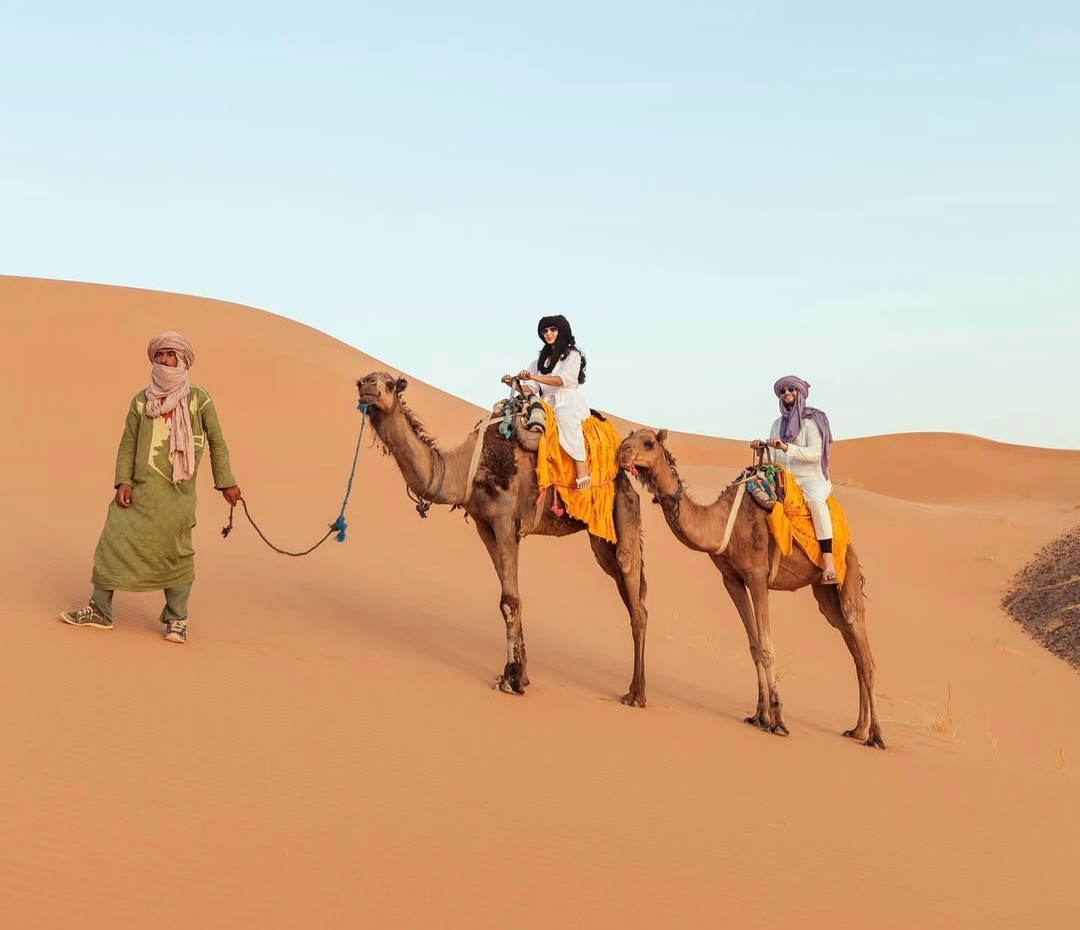
Once you reach Merzouga, you’ll typically leave your main luggage with the support vehicle and take a small bag for the camel trek itself. The ride out to camp usually times itself around sunset, so the light show over the dunes happens while you’re still on the camel. Dinner at camp is a traditional Moroccan meal, often followed by Berber drumming around a fire, and the night ends with genuinely dark skies well away from any city light. Most travelers head out again before sunrise the next morning to watch the light change over the dunes before breakfast.
Top Things to Do in the Sahara Desert
- Camel trekking, the classic way to reach camp and watch the sunset or sunrise over the dunes.
- Sandboarding, sliding down the steeper dune faces on a board, similar to snowboarding.
- 4×4 desert excursions, reaching parts of the desert a camel trek doesn’t cover, including smaller villages and fossil sites near Erfoud.
- Visiting a nomadic or Berber family, often arranged through your guide, with mint tea and a conversation about daily life in the desert.
- Stargazing, since Merzouga has almost no light pollution and clear desert air, making it one of the better stargazing spots in North Africa.
- Khamlia and Gnawa music, a nearby village known for a musical tradition with West African roots, often included as an evening stop.
What to Pack for the Sahara Desert
Desert packing comes down to one rule, plan for two very different temperatures in the same day. Lightweight, breathable clothing works for daytime, but you’ll want a warm layer, even in spring or fall, once the sun goes down. A few specifics worth adding to your bag:
- A long scarf or shesh to wrap around your head and face during windy or sandy stretches.
- Sunscreen, sunglasses, and a hat, since there’s no shade once you’re out on the dunes.
- Comfortable, closed shoes for the camel trek and walking on sand.
- A light jacket or fleece for desert camp evenings, plus warmer layers if you’re traveling between November and February.
- A flashlight or headlamp and a portable charger, since camps have limited outlets.
- A reusable water bottle, since dehydration is the most common issue on desert excursions.
How Much Does It Cost to Visit the Sahara Desert in Morocco?
As a private tour operator, every Sahara trip we run is custom-built around your group rather than sold as a fixed package, so pricing depends on your group size, chosen accommodation, travel dates, and trip length. As a general guide, private Sahara tours generally start from around $540 per person for a shorter itinerary. Larger groups bring the per-person cost down since the vehicle and driver are shared among more people, while smaller groups or solo travelers pay more for the same level of privacy and flexibility. The most accurate way to get a number is to contact us with your travel dates and group size for a clear, all-inclusive quote.
Is a Sahara Desert Trip in Morocco Worth It?
For most travelers, yes. A Sahara trip is consistently one of the most talked-about parts of a Morocco itinerary, not just for the dunes themselves but for everything along the route: the mountain passes, the kasbahs, the Berber villages, and the contrast between the desert night and the cities you started from. It does take real time and a long drive to get there, so it’s worth building at least three days into your Morocco itinerary if you want to include it without feeling rushed.
Frequently Asked Questions
How many days do I need to visit the Sahara Desert in Morocco?
Three days is the minimum for a round trip from Marrakech or Fes, giving you one night in the desert and two travel days. Four days or more lets you add extra stops, such as the Dades Valley or Todra Gorge, without long back-to-back driving days.
Can I visit the Sahara Desert as a day trip from Marrakech?
Not to Erg Chebbi. The drive alone takes 9 to 10 hours each way, so a genuine day trip isn’t practical. Travelers short on time sometimes visit Agafay Desert near Marrakech instead, which offers a desert-style experience without the long drive, though it isn’t part of the Sahara itself.
Is it safe to travel to the Sahara Desert in Morocco?
Yes, when you travel with a licensed local operator. Roads to Merzouga are well-traveled, and desert camps are set up specifically for tourism, with experienced guides who know local conditions, including how to handle sandstorms or extreme heat.
Do I need a 4×4 to reach the Sahara Desert?
Not for Erg Chebbi, which is reachable by paved road all the way to Merzouga. A 4×4 is only necessary for Erg Chigaga, which requires an off-road transfer from M’Hamid to reach the dunes.
Can I bring children on a Sahara Desert tour?
Yes. Private tours are flexible enough to build in extra rest stops, and camel treks can be shortened or replaced with a 4×4 transfer to camp if needed.
Planning Your Sahara Trip
Visiting the Sahara Desert in Morocco takes some planning around the route, the season, and the type of trip that fits your schedule, but it’s a manageable part of a Morocco itinerary once you know what to expect. Whether you’re starting from Marrakech, Fes, Casablanca, or Tangier, our team can build a private desert itinerary around your dates and group size. Browse our full range of Morocco desert tours or contact us directly for a personalized quote.