Jemaa el Fnaa Square, Marrakech
Jemaa El Fnaa is the beating heart of Marrakech, a sprawling square in the middle of the old city where snake charmers, storytellers, and food vendors have gathered for close to a thousand years. It sits at the entrance to the medina, within walking distance of the Koutoubia Mosque, and it changes completely between morning and midnight, making it one of the few places in the world where a single square can feel like two entirely different destinations depending on when you arrive.
For most travelers, a trip to Marrakech isn’t complete without standing in this square at least once, ideally at sunset when the orange juice carts give way to smoking grills and the crowd triples in size. Whether you’re here to shop the surrounding souks, sample Moroccan street food, or simply watch the city go about its evening, this guide covers everything you need to plan your visit, along with the history and context that make the square worth understanding, not just photographing.
If you’d rather explore Jemaa El Fnaa with a local driver-guide as part of a wider trip, our private tours from Marrakech are built around exactly this kind of experience, with plenty of time in the medina and no rigid group schedule to work around.
The History of Jemaa El Fnaa
Marrakech was founded in 1070 by the Almoravid dynasty, and Jemaa El Fnaa has been at the center of the city for almost as long. It began as an open meeting ground just outside the royal kasbah, used for markets, public gatherings, and, for several centuries, public executions carried out by the ruling dynasties of the time. Caravans arriving from the Sahara and traders coming up from sub-Saharan Africa would stop here to sell goods, exchange news, and rest before continuing their journeys, which is part of why the square developed such a mix of cultures, languages, and traditions early on.
By the 16th century, under the Saadian dynasty, Jemaa El Fnaa had firmly established itself as the commercial and social center of the medina, a role it has never really lost. Storytellers, healers, musicians, and performers began using the square as an open-air stage, a tradition that continues today with musicians, acrobats, and other performers who still work the crowds every evening.
What Does “Jemaa El Fnaa” Mean?
The name has no single agreed-upon translation, which is part of its appeal. The most widely repeated interpretation is “Assembly of the Dead,” a reference to public executions once held on the square, with the heads of executed criminals reportedly displayed on the surrounding walls as a warning. A second, less grim reading translates the name as “Mosque at the End of the World” or “Assembly of Nothingness,” referring to an unfinished mosque that Sultan Ahmad al-Mansur began building on the site in the late 1500s but never completed, possibly due to outbreaks of plague. Local guides in Marrakech will often share their own version of the story, and historians themselves are not entirely settled on which explanation is correct, but the mix of interpretations says a lot about how layered the square’s history really is.
Jemaa El Fnaa’s UNESCO World Heritage Status
In 2001, UNESCO recognized the cultural space of Jemaa El Fnaa as a Masterpiece of the Oral and Intangible Heritage of Humanity, one of the first sites in the world to receive that designation. The listing wasn’t for the physical square itself, but for the living traditions that take place there: storytelling, music, poetry, and performance passed down through generations of Marrakchi families. That distinction matters, because it’s part of why the square has kept its character instead of turning into a fenced-off monument. The performers you’ll see tonight are, in many cases, continuing a craft their fathers and grandfathers practiced in the same spot.
Things to Do
There’s no single “right” way to see the square, and most visitors end up returning more than once during their stay, since the atmosphere shifts so much between daytime and evening.
Wander the Marrakech Souks
The souks border the square on its northern side and are worth setting aside real time for. Expect narrow, covered lanes packed with leather goods, hand-loomed carpets, brass lanterns, spices sold by the cone, and stalls of babouche slippers in every color. Bargaining is expected everywhere, so treat the first price you’re quoted as a starting point, not the final number, and don’t feel pressured to buy from the first stall you stop at.
Watch the Snake Charmers, Storytellers, and Musicians
By late morning, snake charmers, henna artists, and Gnawa musicians with their metal qraqeb castanets begin setting up around the edges of the square. Storytellers, known locally as halqaoui, still gather small crowds and perform entirely in Darija, Moroccan Arabic, even though most listeners today are tourists rather than the local audiences these performers traditionally served. If you photograph a performer or accept henna, agree on a price beforehand, a tip is expected in most cases, and settling the amount in advance avoids any confusion afterward.
Relax at a Rooftop Café
Several cafés and restaurants on the square’s edge have rooftop terraces, and they’re the best way to take in the whole scene without being in the middle of the crowd. Ordering a mint tea or fresh orange juice and watching the square from above, especially as the sun starts to drop, is one of the simplest and most rewarding things to do here.
Jemaa El Fnaa at Night
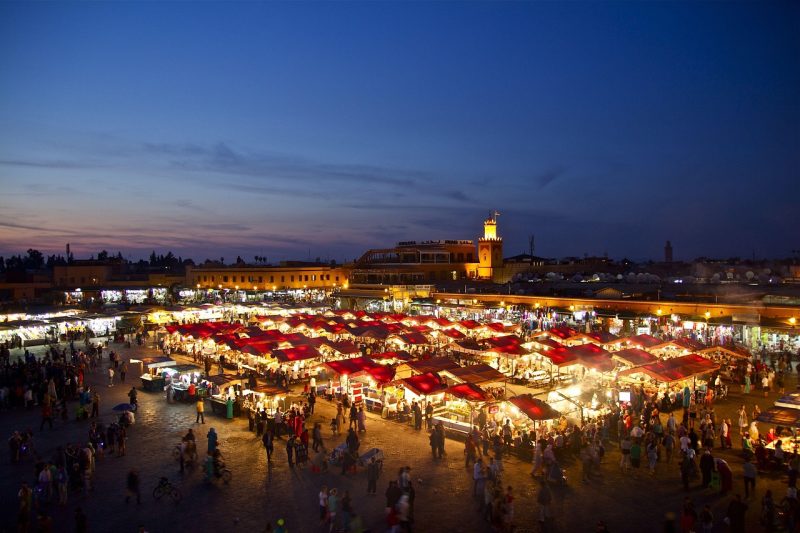
This is when the square earns its reputation. As the sun sets, dozens of food stalls appear almost out of nowhere, each marked with a numbered sign, and the smoke, grilled meat, and calling vendors take over the center of the square. Musicians and performers cluster in loose circles, and the crowd grows considerably compared to daytime. If you only have time to visit once, evening is the version of Jemaa El Fnaa worth prioritizing, ideally arriving just before sunset so you can watch the transition happen in real time.
What to Eat
Food is the main draw for a lot of travelers, and the options at the evening stalls are genuinely extensive: grilled kebabs and merguez sausage, tagine, harira soup, fried fish, Moroccan salads, and, for the more adventurous, snail soup and other traditional offal dishes. Fresh orange juice is sold from carts throughout the day and is one of the best-value things you can buy in the square, though it’s worth asking for it without ice if you want it made fresh in front of you rather than pre-mixed. In the evening, pick a stall that’s busy with a mix of locals and visitors, since that’s usually a sign of quality and turnover, and always confirm the price before you order rather than after your food arrives.
Best Time to Visit
Jemaa El Fnaa looks and feels different depending on when you show up, and there’s no single wrong time to visit, just different experiences.
- Morning: quieter, fewer vendors, best for photos of the square itself and an easy walk into the souks before they get busy
- Midday: hot, especially in summer, but a good window for souk shopping since crowds are thinner
- Late afternoon: the square starts filling in, food stall vendors begin setting up, and rooftop cafés start to get busy
- Evening, just before sunset: the best all-around time, with the transition from day to night happening in front of you
- Night: the busiest and most active version of the square, with performers, food stalls, and the largest crowds
Spring (March to May) and fall (September to November) offer the most comfortable weather for walking around, while summer visits are best handled with an early morning or after-dark schedule to avoid the midday heat.
Is Jemaa El Fnaa Safe?
Jemaa El Fnaa is generally safe and heavily trafficked by both locals and tourists, but it’s still a crowded public square, so ordinary precautions apply. Keep your phone, wallet, and passport secured, particularly in the denser evening crowds and inside the souks. A few things worth knowing in advance:
- Performers with monkeys or snakes will often place them near you for a photo opportunity and then ask for payment afterward, so it’s best to keep your distance if you don’t want to pay
- Henna artists sometimes apply henna to a hand or arm before agreeing on a price, so settle the cost first or decline politely and keep walking
- Prices at food stalls and juice carts can vary for tourists versus locals, so ask before ordering rather than after
- If you’re not interested in an offer of any kind, a firm but polite “no, thank you” is normally enough
None of this should discourage a visit. It’s simply the kind of practical knowledge that makes a first trip to a busy, unfamiliar square go more smoothly.
How to Get to Jemaa El Fnaa
The square sits at the entrance to the medina, so if your riad or hotel is inside the old city, you can likely walk there directly, though the medina’s narrow streets can be disorienting for first-time visitors. From outside the medina, a taxi can drop you at one of the nearby access points, since much of the immediate area around the square is pedestrian-only. Marrakech Menara Airport is about 15 to 20 minutes away by car depending on traffic. A downloaded offline map helps a lot here, and if you’d rather not navigate the medina alone on your first day, arranging a private driver-guide for your Marrakech arrival takes that stress off the table entirely.
What to See Near Jemaa El Fnaa
The square’s location makes it an easy base for a full day in the medina rather than a single stop.
- Koutoubia Mosque: Marrakech most recognizable landmark, a short walk from the square, with a minaret that has defined the city’s skyline since the 12th century
- Bahia Palace: a 19th-century palace known for its carved cedar ceilings and tiled courtyards, about a 15-minute walk away
- Marrakech Souks: the traditional market district bordering the square directly to the north
- Secret Garden (Le Jardin Secret): a restored 19th-century riad garden tucked a few streets into the medina
Rather than treating Jemaa El Fnaa as an isolated stop, most travelers build it into a full day that includes the souks, a couple of nearby historic sites, and a return visit in the evening for dinner and the performers.
Explore Jemaa El Fnaa With a Local, Family-Run Team
We’re a family-run Morocco travel company based in Marrakech, and Jemaa El Fnaa is a starting point for most of the private tours we run, from single-day medina walks to multi-day circuits that continue on to Fes, the Sahara, or the Atlas Mountains. Our drivers and guides know the square well enough to time your visit around the crowds, point you toward food stalls that are worth eating at, and make sure the souk visit doesn’t turn into an afternoon of pressure tactics from shopkeepers. If you’d like the square built into a wider Morocco itinerary, our team can put together a custom private tour around your dates and interests.
Frequently Asked Questions About
What is Jemaa El Fnaa famous for?
It’s famous for being the cultural and commercial heart of Marrakech’s medina, known for its evening food stalls, musicians, storytellers, and its UNESCO-recognized status as a center of living oral heritage.
What does the name Jemaa El Fnaa mean?
There’s no single agreed translation. The most common interpretation is “Assembly of the Dead,” referring to historical public executions on the site, though some historians connect the name instead to an unfinished 16th-century mosque once planned for the square.
What is the best time to visit Jemaa El Fnaa?
Late afternoon into evening, arriving just before sunset, gives you the best of both worlds: a calmer square to start and the full transition into its livelier nighttime version.
How long should I spend at Jemaa El Fnaa?
A couple of hours is enough for a first pass, but most visitors end up spending longer once they factor in the souks, a rooftop café stop, and a return visit after dark.
Is Jemaa El Fnaa safe to visit?
Yes, it’s a busy, well-trafficked public square, but normal precautions around valuables and pricing still apply, particularly with performers and food vendors.
What food should I try in Jemaa El Fnaa?
Grilled meats, tagine, harira soup, and fresh orange juice are the standouts, along with more adventurous options like snail soup for travelers who want to try something less familiar.
Is Jemaa El Fnaa free to visit?
Yes, the square itself is free and open at all hours. You’ll only pay for food, drinks, souk purchases, or if you choose to tip a performer or accept a service like henna.
Can I visit Jemaa El Fnaa on a day trip from Marrakech?
Jemaa El Fnaa is inside Marrakech itself, so it’s not a day trip destination on its own, but it pairs naturally with a day exploring the medina before or after excursions like our day trip to Ourika Valley or day trip to Essaouira.