Culture of Morocco
The culture of Morocco is one of the richest and most layered in the world, shaped by more than a thousand years of Amazigh (Berber), Arab, African, and European influence. From the call to prayer echoing across Fes at dawn to the smell of fresh mint tea poured in a Marrakech riad, Moroccan culture reveals itself in small daily rituals as much as in grand festivals. Understanding Moroccan traditions, food, and etiquette before you travel doesn’t just make your trip smoother, it helps you connect more genuinely with the more than 38 million people who call this North African kingdom home.
As a family-run tour operator that has spent over 25 years building private itineraries across Morocco, we’ve watched travelers fall in love with this culture again and again, not because of any single monument, but because of how the country lives its heritage every day. This guide covers everything you need to know about the culture of Morocco, from history and religion to food, music, dress, and the best places to experience it all in person.
What Is Morocco Known For Culturally?
Morocco is known for its colorful souks, aromatic spices, warm hospitality, and centuries-old architecture. But reducing Moroccan culture to a list of postcards misses the point. Morocco is a genuine cultural crossroads, where indigenous Amazigh traditions meet Arab-Islamic civilization, sub-Saharan African heritage, and decades of French and Spanish influence, all without losing its own distinct identity.
Among the most iconic cultural symbols of Morocco are its traditional clothing, flavorful cuisine, spiritual music, detailed handicrafts, and famously welcoming attitude toward guests. Whether you’re standing in a bustling medina or a quiet Berber village in the Atlas Mountains, the Moroccan lifestyle is deeply rooted in this shared culture.
- You can read more in our guide to what Morocco is famous for.
A Brief History Behind Moroccan Culture
Understanding where Moroccan culture comes from helps explain why it feels the way it does today. Indigenous Amazigh peoples have inhabited the region for thousands of years, long before Phoenician traders, Roman settlers, Arab dynasties, and French colonizers arrived. Each left an imprint that is still visible in Moroccan traditions today.
In 788 AD, the Idrisid dynasty founded the first Moroccan Islamic state. Later dynasties, including the Almoravids, Almohads, and Marinids, brought the architectural and intellectual achievements that still define cities like Fes and Marrakech. Morocco became a French protectorate in 1912 and regained full independence in 1956. Today it is a constitutional monarchy under the Moroccan royal family, and its capital is Rabat, not Marrakech or Casablanca as many visitors assume. You can read more about the capital of Morocco and why it holds this role.
Morocco is also entering a new chapter on the world stage: alongside Spain and Portugal, it will co-host the 2030 FIFA World Cup, with matches planned for Marrakech, Casablanca, Rabat, Fes, Tangier, and Agadir. It will be the first World Cup held on both African and European soil, and it’s already accelerating investment in the country’s cities and cultural infrastructure.
Population, People, and Languages of Morocco
Morocco population passed 38.8 million in 2026, with the majority of citizens of Berber (Amazigh), Arab, or mixed Arab-Berber descent. Roughly two-thirds of the population now lives in urban centers like Casablanca, Rabat, and Fes, though rural and mountain communities remain central to the country’s cultural identity.
Languages Spoken in Morocco
Morocco official languages are Arabic and Amazigh (Tamazight), which gained official constitutional status in 2011. Modern Standard Arabic is used in government and media, while Darija, or Moroccan Arabic, is what people actually speak day to day. Amazigh is widely spoken in mountain and rural regions and remains a strong symbol of indigenous identity, written in the revived Tifinagh script.
French is also widely spoken, particularly in business, education, and tourism, a legacy of the protectorate era. Spanish is common in the north, and English is increasingly spoken in tourist hubs, especially among younger Moroccans.
Religion in Moroccan Culture
Islam sits at the center of daily life in Morocco. The vast majority of Moroccans follow Sunni Islam under the Maliki school of jurisprudence, and its influence shows up in clothing, food, festivals, and everyday social customs. The call to prayer sounds five times a day across every city and town.
Despite being a Muslim-majority country, Morocco has a long history of religious coexistence. Small Christian and Jewish communities have lived alongside Muslim Moroccans for centuries, particularly in cities like Casablanca, Rabat, and Essaouira, and this pluralism remains a point of national pride.
Religious Holidays and Festivals in Morocco
Moroccan religious holidays follow the Islamic lunar calendar and include:
- Ramadan: a month of fasting and reflection, with families gathering each evening for iftar.
- Eid al-Fitr: the joyful celebration that ends Ramadan, marked with new clothes and shared meals.
- Eid al-Adha: a holiday honoring the Prophet Abraham’s faith, when families share meat with neighbors and those in need.
- Mawlid al-Nabi: a celebration of the Prophet Muhammad’s birthday, marked with religious songs and family gatherings.
Beyond religious holidays, Morocco hosts some of North Africa’s most celebrated cultural festivals, and they’re a major reason people search for the best time to experience Moroccan culture firsthand. The Fes Festival of World Sacred Music draws global musicians each spring, the Gnaoua World Music Festival in Essaouira fills the coastal city with trance rhythms every June, Mawazine in Rabat is one of the largest music festivals in Africa, and the Rose Festival in El Kelaa M’Gouna celebrates the Dades Valley’s rose harvest every May.
Traditional Moroccan Clothing
Traditional Moroccan clothing, though it varies by region, is a powerful symbol of cultural pride. These garments combine function, modesty, and detailed craftsmanship that reflects the country’s layered heritage.
Key traditional outfits include:
- Djellaba: a long, hooded robe worn by both men and women, typically in wool or cotton.
- Kaftan: a luxurious embroidered dress worn by women for weddings and special occasions.
- Gandoura: a sleeveless robe worn by men in warmer months.
- Babouches: colorful leather slippers worn indoors and out.
The Moroccan caftan received major international recognition in December 2025, when UNESCO officially inscribed it on the Representative List of the Intangible Cultural Heritage of Humanity, cementing its status as one of the country’s most treasured cultural exports. You can read the full story in our article on the Moroccan caftan.
Moroccan Wedding Traditions
Moroccan weddings are grand, multi-day events that showcase the richness of local customs. A henna ceremony is usually held the night before, decorating the bride’s hands and feet. Brides often wear several different kaftans throughout the celebration and are presented to guests in a traditional “amariya,” a decorated bridal chair carried above the crowd. Traditional music styles like Aissawa, Andalusian, and Chaabi accompany the celebration, alongside lavish feasts of pastilla, lamb tagine, and sweets.
Moroccan Food Culture
Moroccan food culture is considered one of the most flavorful in the world, blending Arab, Amazigh, Andalusian, and French culinary traditions.
Featured dishes include:
- Tagine: a slow-cooked stew of meat, vegetables, and spices, named for the clay pot with a pointed lid it’s cooked in.
- Couscous: steamed semolina grain traditionally served on Fridays with meat and vegetables.
- Pastilla: a sweet-and-savory pie made with thin pastry, spiced meat, and a dusting of powdered sugar and cinnamon.
- Harira: a rich tomato, lentil, and chickpea soup traditionally eaten to break the Ramadan fast.
- Mechoui: whole lamb roasted slowly on a spit for weddings and special gatherings.
Moroccan Mint Tea Culture
Mint tea, often nicknamed “Moroccan whisky,” is the national drink, brewed with green tea, fresh mint, and plenty of sugar. It’s poured from a height with real ceremony, and offering it to a guest is one of the clearest expressions of Moroccan hospitality.
Moroccan Architecture and Design
Moroccan architecture and culture are inseparable. Whether in imperial cities or remote villages, buildings across the country double as works of art.
Key architectural features include:
- Zellige tiles: intricate geometric mosaics used on walls and floors.
- Riads: traditional homes built around a central interior garden.
- Horseshoe arches: a hallmark of Islamic architectural style.
- Ksour and kasbahs: fortified earthen villages and homes found across the south.
Rabat architectural heritage carries particular weight: its historic center was inscribed as a UNESCO World Heritage Site in 2012 under the title “Rabat, Modern Capital and Historic City: A Shared Heritage,” recognizing how the capital blends 20th-century urban planning with centuries of older architecture. Marrakech, Fes, and Chefchaouen are also outstanding places to explore Moroccan design in person.
Moroccan Music and Dance
Moroccan music is remarkably diverse, and it plays a central role in festivals, weddings, and everyday life.
Popular genres include:
Gnawa: spiritual, trance-inducing music rooted in West African tradition. UNESCO inscribed Gnawa on its Representative List of the Intangible Cultural Heritage of Humanity in 2019, recognizing its centuries-old rituals and role in Moroccan identity.
- Chaabi: upbeat folk-pop played at parties and celebrations.
- Andalusian classical music: refined Arab classical music, often performed in northern cities.
- Malhoun: a form of sung Arabic poetry that UNESCO added to the same heritage list in 2023.
- Amazigh music: traditional rhythms played on instruments like the bendir and rebab.
Moroccan Hospitality
Moroccan hospitality is renowned worldwide. Guests are treated like family, and it’s common to be invited into someone’s home or offered tea in a shop within minutes of meeting.
- Generosity means welcoming guests with food, a place to stay, and time, without hesitation.
- Warmth shows up in how readily Moroccans strike up conversation, even with strangers.
- Trust is built slowly, but once earned, it’s valued deeply.
Visiting a Moroccan Home
If you’re lucky enough to be invited into a Moroccan home, keep a few customs in mind:
- Remove your shoes at the door.
- Accept tea and food graciously; declining is generally considered impolite.
- Compliment the food and your host.
- Bring a small gift if you can, such as sweets or fruit.
Dress Code in Morocco
Women traveling in Morocco are encouraged to dress modestly out of respect for local culture. You don’t need to cover your head, but loose-fitting clothing that covers your shoulders, chest, and knees is recommended, especially in rural areas and religious sites.
Men typically wear jeans or long trousers with sleeved shirts. Sleeveless tops and very short shorts are best avoided near mosques, markets, and in more conservative towns. A little cultural awareness here goes a long way toward positive interactions with locals.
Moroccan Souks and Markets
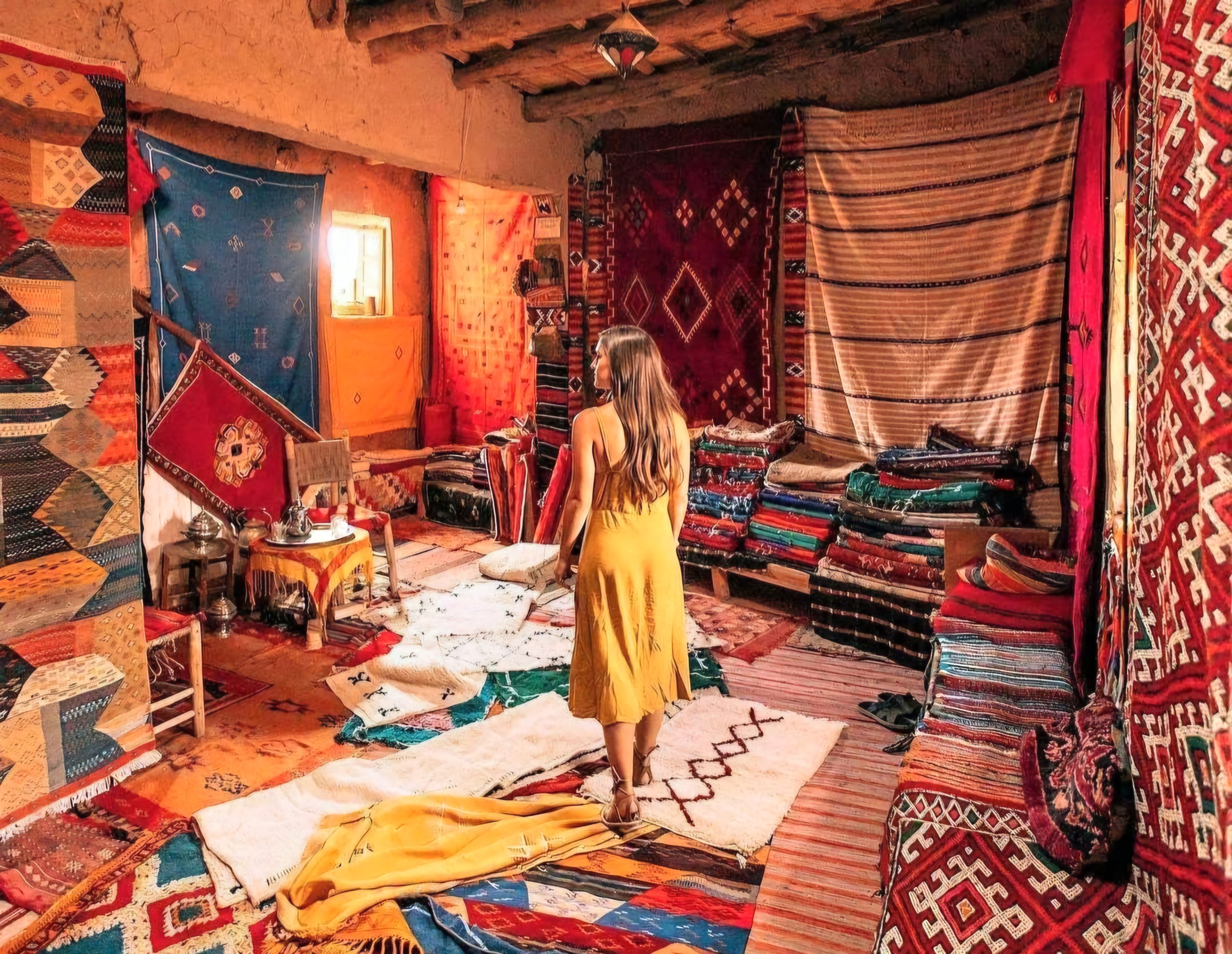
No visit to Morocco is complete without exploring a traditional souk, the lively markets that sit at the center of everyday life.
- Spices: cumin, saffron, ginger, and ras el hanout.
- Textiles: scarves, rugs, and caftans in every color.
- Crafts: pottery, leather goods, lanterns, and metalwork.
Negotiating is part of the experience and a genuine way to connect with local vendors.
Moroccan Handicrafts
Handmade crafts remain a vital part of Moroccan heritage, passed down through generations of artisans.
- Ceramics from Fes and Safi.
- Carpets woven by Berber women.
- Brass and silver lanterns from Marrakech.
- Argan oil products from the south.
Tipping in Morocco
Tipping is an expected part of Moroccan hospitality culture. A standard restaurant tip is around 10%, hotel staff typically receive about 50 MAD, and tipping for guides and drivers varies with the length and quality of your Morocco tour. Read our full breakdown of tipping in Morocco before you go.
Drink Culture in Morocco
Alcohol is legal in Morocco but isn’t a significant part of everyday culture. Popular drinks instead include mint tea served throughout the day, fresh orange, avocado, and pomegranate juices, and coffee, particularly the local nous-nous, made with half milk and half espresso. Alcohol is available in licensed restaurants, hotels, and bars, and should be consumed respectfully.
Best Places to Experience the Culture of Morocco
If you want to see Moroccan culture in action rather than just read about it, these are the places that bring it to life.
- Jemaa el Fnaa, Marrakech: the country’s most iconic square, a UNESCO-recognized Cultural Space where storytellers, musicians, and food vendors have gathered for nearly a thousand years. Read more about Jemaa el Fnaa.
- Fes el Bali: Morocco cultural and spiritual capital, home to the ancient tanneries and the University of al-Qarawiyyin, founded in 859 AD and recognized by UNESCO and Guinness World Records as the oldest continuously operating degree-granting university in the world.
- Chefchaouen: the famous “Blue City” in the Rif Mountains, known for its Andalusian-influenced architecture and laid-back mountain culture.
- Essaouira: a relaxed coastal town and home of the Gnaoua World Music Festival, with Portuguese-built ramparts and a strong artisan community.
- Rabat: the political and cultural capital, home to the Kasbah of the Udayas and a UNESCO World Heritage-listed old town.
- Ait Benhaddou: a striking UNESCO-listed ksar near Ouarzazate, showcasing traditional Amazigh earthen architecture and centuries-old caravan routes.
FAQ’s About the Culture of Morocco
What are the main influences on the culture of Morocco?
Moroccan culture draws primarily from Amazigh (Berber), Arab, sub-Saharan African, and European traditions, shaped over centuries of trade, migration, and dynastic rule.
What language do people actually speak in Morocco?
Most Moroccans speak Darija, or Moroccan Arabic, in daily life, alongside Amazigh in many regions. Modern Standard Arabic, French, and increasingly English are also widely used.
Is Morocco a religiously tolerant country?
Yes. While the vast majority of Moroccans are Sunni Muslim, the country has a long history of religious coexistence, including small Christian and Jewish communities that remain active today.
What should I wear to respect Moroccan culture as a tourist?
Modest, loose-fitting clothing that covers the shoulders and knees is recommended for both men and women, particularly in rural areas, markets, and religious sites.
What is Morocco most famous cultural symbol?
Jemaa el Fnaa in Marrakech is often considered the single most recognizable symbol of Moroccan culture, alongside the traditional kaftan and Gnawa music.
Experience the Culture of Morocco With Us
The culture of Morocco is a living, breathing blend of history, faith, art, and daily ritual, not something confined to a museum. From the medinas of Fes to the Gnawa rhythms of Essaouira, every part of the country carries its own expression of these shared traditions.
As a family-run private tour operator based in Marrakech, we’ve spent over 25 years helping travelers experience this culture the way it’s actually lived, through the people, food, and places that define it. If you’re ready to see it for yourself, explore our private Morocco tours and let us help you plan a trip built around genuine cultural experiences.